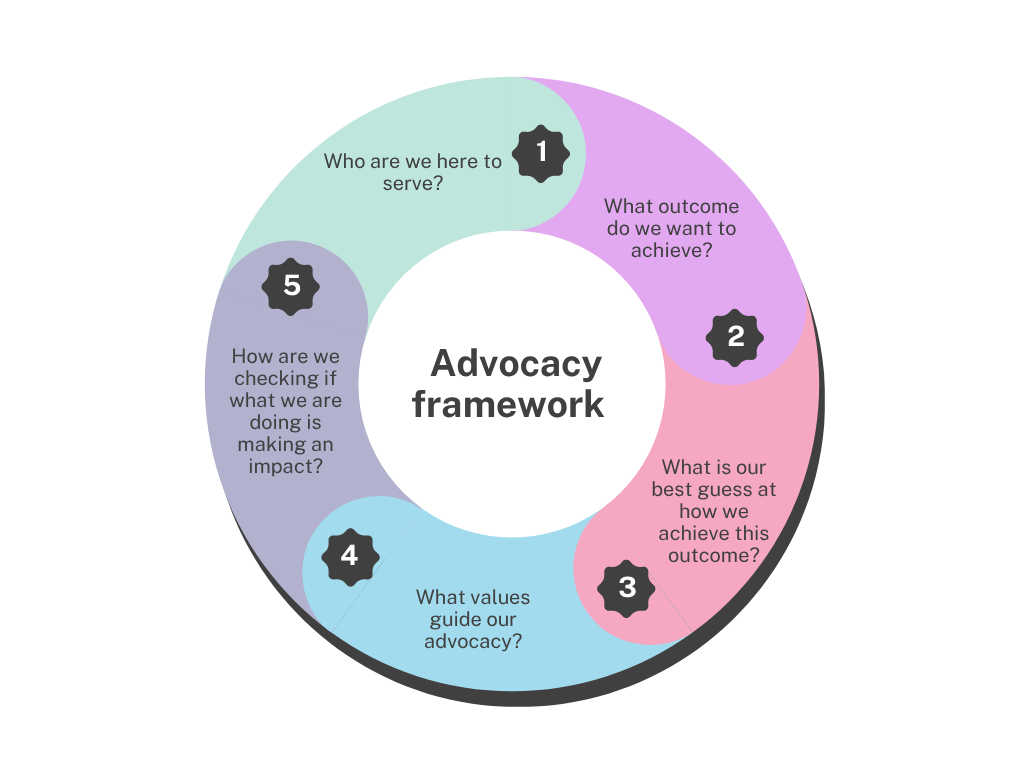
Five questions for developing an advocacy framework
An explainer
The path to achieving change is rarely linear.
There are often many obstacles to overcome internal to the organisation, within a sector and beyond.
Before we develop strategies for specific campaigns, we need to develop a framework to guide our advocacy across an organisation.
In this explainer, we unpack the five questions that organisations need to consider in developing a framework for advocacy.
1. Who are we here to serve?
It all starts with our people or communities. Understanding who we are here to serve is critical to ensuring that our advocacy helps to advance the outcomes that we seeking for our communities.
It also helps us to answer the important question of ‘Did the advocacy we engaged in today make a difference to the lives of the people we are here to serve?’ and ‘How do we know this?’.
Our advocacy is more impactful and grounded if it we have a clear understanding of our people and clear mechanisms to ensure that we are connected with and guided by these communities. This includes checking in around how we are going regularly in a real and meaningful ways.
2. What outcome do we want to achieve?
This is all about having a clear outcome for our people or communities.
Some questions that help us to identify this are ‘What outcome are we seeking to improve the lives/ health/ wellbeing of our community?’ and ‘What does it look like when we no longer need to exist because our advocacy aims have been achieved?’.
If we don’t articulate a clear outcome for our advocacy in our organisation’s vision and in each of our advocacy strategies, then we don’t know what we are trying to achieve and if we are getting closer to that goal.
3. What is our best guess at how we achieve this?
Change theories can often be presented in complex ways. But at the heart of the question ‘What is our change theory?’, is the simple proposal of how we see our organisation influencing the change we are seeking.
It can be a short statement that says ‘If we do X, then Y, they will do Z and change will happen because A.’ For example you might have a change theory that says ‘If we undertake research and develop innovative policies to address this problem, and then engage with decision makers and their influencers around these ideas, and share them in popular media, the government will adopt them because they will feel the pressure from within, their influencers and the community.’
Having a documented change theory also allows you to test your best guess at how you will drive change.
Without a change theory that articulates how we will advocate and why we think these types of advocacy will be effective, there is a risk that there will be a lack of clarity around how our organisation drives change. It will also be difficult to measure our advocacy.
4. What values guide our advocacy?
Throughout our advocacy, we will be faced with difficult questions. These might relate to the possible risks of action or inaction, or of the ambition of our policies in achieving the outcomes that we are seeking for our people or communities.
There may be disagreement on positions taken. There may also be disagreements on approaches taken in advocacy.
When we encounter these disagreements, we need to be able to refer to a set of values that are clear and are commonly understood across the organisation. We can then ask, ‘Does this align with our agreed values?’ and ‘Why or why not?’.
5. How are we checking if what we are doing is making an impact?
Like all projects and areas of work, the impact of our advocacy should be measured. Setting up a clear measurement framework against our change theory is important to ensure that we are accountable to the people and communities that you are here to serve.
This measurement should include progress markers along the way that demonstrate impact. If impact isn’t being demonstrated, it should allow for our organisations to go back to the drawing board and test another approach or theory on how to drive change.
9 June 2026
For Purpose holds training on policy, advocacy, communications, media engagement and more. Find out more here.