
Developing a tangible policy ask
An FP Explainer
Organisations working to advocate for change are very aware of the problems their communities face.
These problems are often varied and far-reaching and include things like a lack of affordable housing, the access that corporations and lobbyists have to decision makers, the cost of dental care, or difficulty in accessing early childhood education.
When making recommendations to governments on possible solutions to address these problems, developing a tangible ask is one of the first steps in the process.
So, what is a tangible ask?
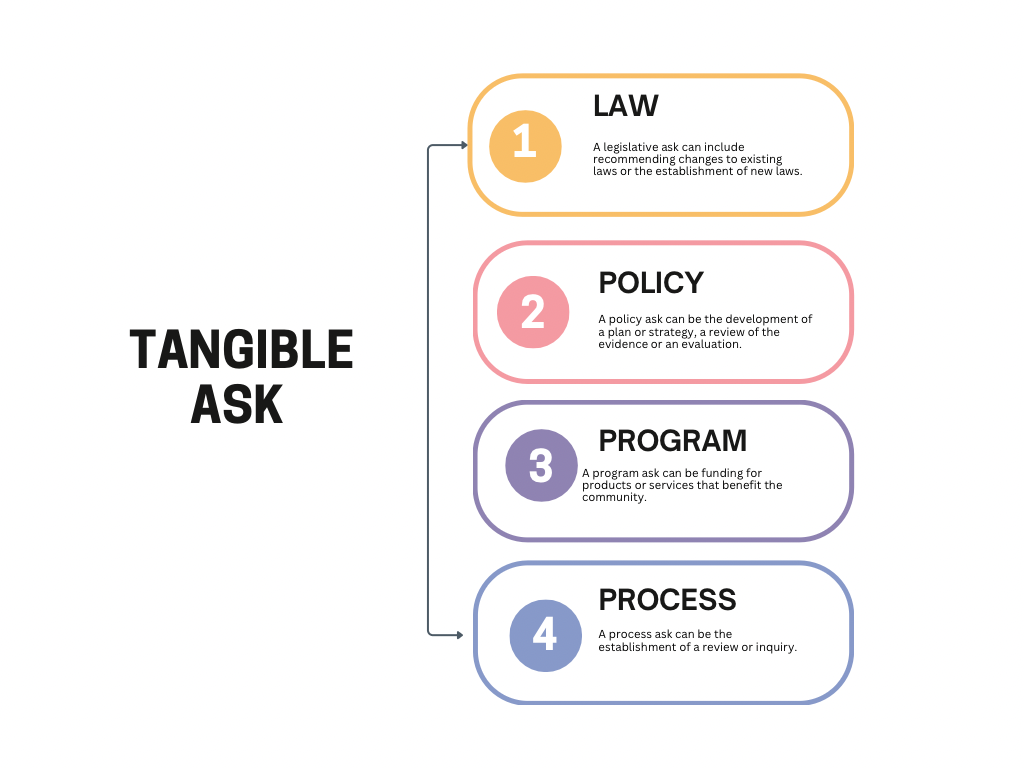
When developing an ask, these usually relate to a law, policy, program or process.
Let’s unpack these.
Law
A legislative ask can include recommending changes to existing laws or the establishment of new laws.
An example of this is recommending changes to the Privacy Act 1988, to ensure that people are appropriately protected in digital environments.
The more specific the recommendation, the better. If you can outline the part of the Act that needs updating and propose suggested wording, this can help to ensure that the intent of your recommendation is not lost in translation.
When considering a legislative ask, the following questions can help:
- Is new legislation needed?
- Is change to existing legislation needed?
- What level of government and which Minister is responsible for the legislation?
- Can this be dealt with through other regulatory instruments, rather than changes to legislation?
- Is this an issue relating to the implementation and interpretation of the legislation, rather than the law itself?
Policy
A policy ask can be related to the development of or updating of a strategy or plan. It could also be policy work that needs to be undertaken, like a review of the evidence, improvement of the collection of data or evaluations.
An example of this is recommending that the government develop a new National Oral Health Plan.
As with the legislative ask, the more specific a policy ask – the better. If you are calling on the government to establish a national plan or strategy – you could suggest what the priority areas should be, some of the key actions and measures for success.
When considering a policy ask, the following questions can help:
- Is there a need for a national strategy, framework or action plan?
- Does one of these policy documents need to be updated?
- Is further data collection, analysis or reporting needed?
- Does an evaluation of an existing strategy, plan or program need to be undertaken?
Program
A program ask can relate to seeking funding for a program or service. Many not-for-profit organisations receive funding from governments for services to support communities in a range of ways.
An example of this is recommending that the government continue to provide funding to mental health organisations for helplines and online support services.
Program asks should be fully costed and include a budget to measure impact.
When considering a program ask, the following questions can help:
- Is a new program needed?
- Does an existing program need additional or extended funding?
- Can we demonstrate the impact or success of the service here or elsewhere?
Process
A process ask could relate to the establishment of a review or inquiry.
An example of this is recommending that the federal parliament establish an Inquiry into the AUKUS Agreement.
If you are calling for a parliamentary inquiry, you can look at which committee would best be able to undertake the process and even recommend terms a reference.
When considering a process ask, the following questions can help:
- Is there a need to draw attention to the issue and bring decision makers along through a process?
- What process is best suited for this, eg. a statutory review, a parliamentary Inquiry?
For Purpose has workshops that include discussions of the development of policy asks, including our Policy and Advocacy Intensive, Policy Managers Intensive and Policy Writing training.
9 September 2025